BRITTANY
Brittany is a Celtic region of north-west France.
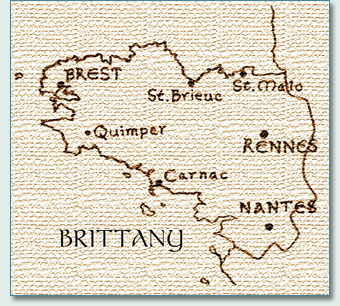
Brittany is a beautiful land of rocky headlands, sheltered bays studded with countless islets, with golden beaches and dramatic coastlines, to a hilly interior of forests and lakes. From mysterious ancient burial mounds on uninhabited islands and rocky headlands, through endless rows of timeless standing stones, to grand medeival chateaux, the land is steeped in myths and legends, from Korrigans (little people) to King Arthur and Merlin.
The Celtic culture is alive and well here with a strong tradition of unique music and dance (see below). In the native Breton language the land is called Breizh, but the ancient Celts called it 'Amor' (the country of the sea), and the Romans called the area 'Armorica'. The region is 'home' to the legendary cartoon characters of Asterix and Obelix, two ancient Gaulish warriors, who with the help of their village druid, hold off the might of the Roman Empire. A creation of Goscinny and Uderzo, the cartoon book series has been popular in Europe for over 40 years.
The Breton language is the only Celtic one spoken on the European continent, spoken by a million people at the beginning of the 20th century, but now only about 250,000 speak it daily, with 600,000 able to understand it.
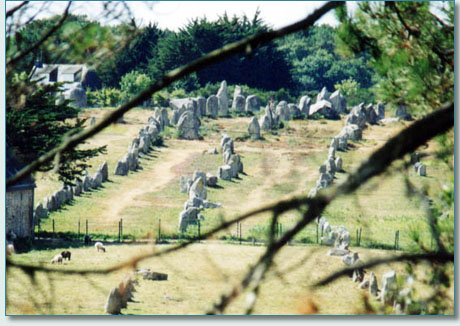
The land is covered with ancient megaliths, menhirs and dolmens, with over 3000 of these in the Carnac area alone. 'Menhir' is a Breton word meaning 'long stones', which are standing stones, arranged in rows, aligning to the movements of the sun and moon at the equinoxes, marking the changing of seasons.
The Carnac standing stones
The ancient Celts revered nature and the elements, and worshipped the sun, moon, the stars and the Earth Mother, with a wide range of goddesses and gods, and Brittany undoubtedly was an important centre. 'Dolmen' is from a Breton word meaning 'stone tables', and they were three standing stones with a huge slab across the top, forming burial chambers. The Bronze Age saw Armorica continue in importance with the need for tin, found here and in Cornwall, a lot of trade went between these lands and on to the rest of Europe. The Celts were settling in the area by 1000 B.C. and thrived until the arrival of the expanding Roman Empire in the 1st century, lasting for the next four.
The next influx of people was a friendly one, with the emigration of Cornish Celts, in the 5th and 6th centuries, escaping the Saxon and Angle invasion of their homeland. These Cornish were the ancient Britons, and gave their name to old Armorica, naming it 'Little Britain'. Christianity first appeared the area in about 450 A.D.
In 799 Charlemagne subjugated Brittany, but 27 years later Nomino, Duke of Brittany united the land, ending Frankish rule. His son Erispoe was named King of Brittany, but assassinated by his cousin Salomon, who extended the kingdom.
The Normans (descended from Vikings) raided Brittany in the early 900s, but were driven out by King Alain Barb-Tort. They did repeatedly return for the next 150 years, and Bretons served in William the Conqueror's army that invaded Saxon England in 1066. In 1158 King Henry 2nd of England invaded Brittany, and his descendants ruled for several generations.
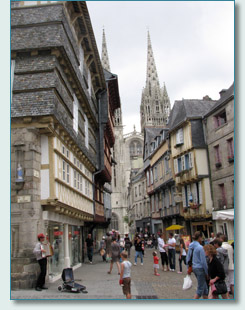
The medieval city of Quimper, Brittany - or Kemper, Breizh
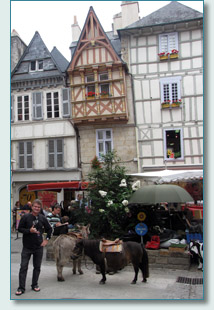
The next 3 centuries were a time of disorder and revolt, until the House of Montfort restored Brittany, and a period of relative peace followed, until war with France ending in 1458 with a French invasion. In 1491 Anne of Brittany married Charles 8th, but remained sovereign, and after his death married Louis 12th. Her daughter Claude married Francois 1st, and the Duchy reunited with France. 1532 saw the Union treaty, and the end of Breton independence. The next 350 years was a time of regular uprisings against French rule.
A Breton Chateau
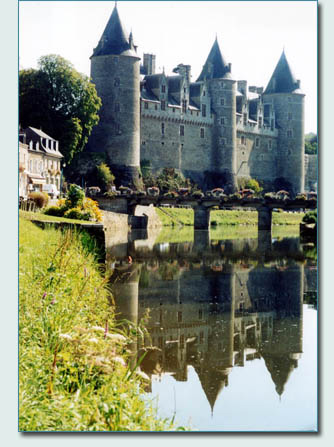
In 1901 the Gorsedd des Bardes was founded, similar to the Welsh and Cornish literary groups, and in 1930 the Breton National Party began a separatist movement. In 1985 Brittany introduced bi-lingual road signs in Breton and French. Breton history is by no means as simple as described above, and more details can be found via our links page.
The Celtic culture is alive and well here with a strong tradition of unique music and dance. There are 2 world famous Celtic music festivals in Brittany, the biggest being the Festival Interceltique de Lorient, with artists from all the Celtic nations.
The other Hamish and Chuck of Maui Celtic visited in 2010, held in the medieval city of Quimper (or Kemper in Breton) - the 5 day Festival de Cornouaille, a huge Celtic festival with 3 stages of music running continuously, as well as a Celtic village of vendors. There was plenty of time to explore the old city, and the Celtic marketplace, with local crafts and Celtic art clothing, jewelry, books and of course, tasty local Breton food.
Celtic Market, Festival de Cornouaille, Quimper, Brittany
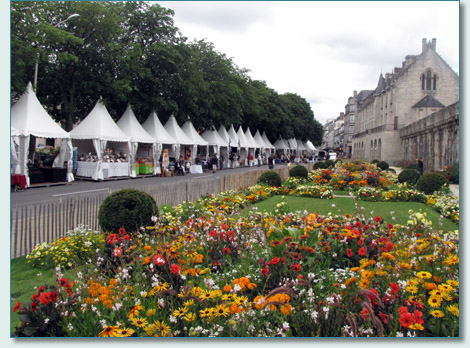
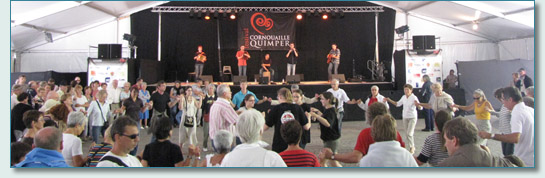
The first afternoon, while exploring the ancient streets of old overhanging buildings, they found the main tent by the Cathedral Saint Corentin, where they saw traditional dance session from a local Celtic band. The folks join hands and dance in rhythmic spirals, winding around eachother - traditional dancing in Brittany is alive and well, with all ages joining in more readily than in any other Celtic nation !
Traditional Breton dance, Festival de Cornouaille, Brittany
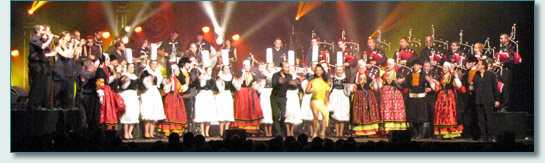
After a walk through the Celtic marketplace on the banks of the Odet River, they found the next big tent, Espace Evêché, and caught part of a concert by the trio Trio Ewen-Delahaye-Favennec. Three legendary Breton men, Patrick Ewen, Gérard Delahaye, and Melaine Favennec, with fiddles, guitars and fine voices. Next was a great group of musicians Arz Nevez et Roland Becker, an original string group of violins, violoncello, guitar and vocal, with compositions by Yves Ribis and Roland Becker. Over to the huge tent of Espace Gradlon, for the evening concert by the brilliant Breton pipe band, Bagad Cap Caval, who put on an amazing show with pipers, drummers, bombard players, local traditional dancers, and even a tango couple ! They were also joined by the Inverary & District Pipe Band from Scotland for a rousing set, as well as guests singer Farid Aït Siameur, percussionist Dominique and Yvon Molard, guitarists Yann-Guirec Le Bars and Tanguy Molard.
Bagad Cap Caval from Brittany
Back across the street, the late night show was by Wig-a-wag, a new trad-fusion modern outfit with a lively stage-show. Twin vocals, guitar, accordion, keyboards, flutes, drums and bagpipes - then the eight piece rocked the crowd with double bagpipe tunes !
With music competitions going on all day in Espace Saint Corentin, our Maui Celtic travellers watched some talented local bombarde and biniou (bagpipe) players compete for trophies, while long snake-like lines of local folks danced their traditional dances to the music. A huge spectacle in the main square was Breizh Omega, with around 350 dancers and musicians, performing in costumes from medieval to modern.
Then the event the lads had come to Quimper and the festival for - over to the huge tent of Espace Gradlon, to a sold-out house to see the amazing Galician piper and flute player Carlos Nuñez. The King of the Pipers is no stranger to Brittany, obviously a favourite of the local crowd, and performed Galician and Breton tunes, as well as from his new themed album Alborada Do Brasil, a Brazilian/Galician musical journey. Chuck had seen Carlos before, and told Hamish how good his live show is, but this concert exceeded all expectations.
Carlos Nuñez and band, with Bagad Kemper at the Festival de Cornouaille
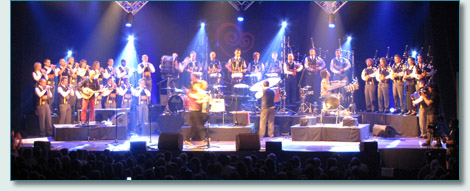
He started with his band and tunes on the recorder, of which his is the master, and was then joined by local Breton pipe band, Bagad Kemper, for a spectacular sound. After more fine music on flutes, some percussion solos, and more with the pipe band, the audience went crazy when he rocked the house with the Galician bagpipes, the gaita.
He was joined on stage by two Breton sisters, the duo Stelenn for some beautiful tunes on twin harps. Then the musicians, members of Bagad Kemper, and folks from the audience joined Carlos on stage for traditional Breton dancing.
Carlos Nuñez and harpists Stelenn at Festival de Cornouaille
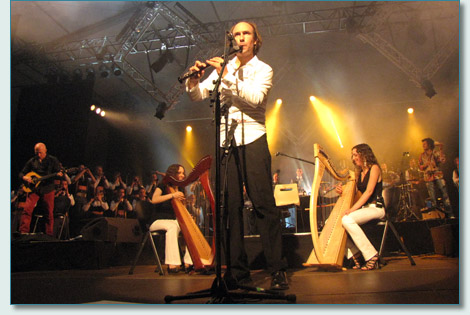
After enjoying most of the concert with Chuck from a great spot in the stands, Hamish moved right down the front to take these photographs. The grand finale was amazing, with Carlos' band, Bagad Kemper, and Stelenn all on stage for some Breton tunes - the house erupted with a huge chain of folks getting up and joining hands for traditional dancing, weaving through the aisles and down by the stage. The thunderous clamour for an encore brought the group back on satge for some wild jigs and reels to end the memorable night.
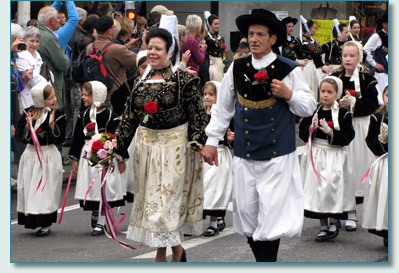
The next morning the Maui Celtic lads met local Celtic music fan and Breton dance and costume expert Collette Marzin at the Défilé en Fête, the grand parade of the Festival de Cornouaille, with 3000 traditional dancers, musicians and singers with Breton regional flags and costumes.
Grand Parade of the Festival de Cornouaille, Quimper, Brittany 2010
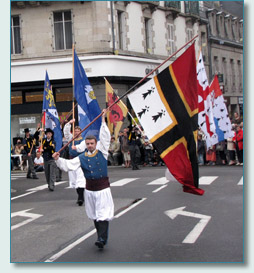


Local Breton pipe band champions Bagad Kemper

She explained the local customs and regional costumes as the grand spectacle filed through the streets of Quimper. Merci to Collette for your hospitality. The festival continued that day and evening, but our Maui Celtic boys sadly had to leave Quimper - they only saw some of the great Breton and other Celtic music acts in the brief time they were there, but it was an amazing experience. Many thanks to Soizick Fonteneau and Romain Gleonec of the Festival de Cornouaille for their hospitality at the event. Please visit this great festival - www.festival-cornouaille.com
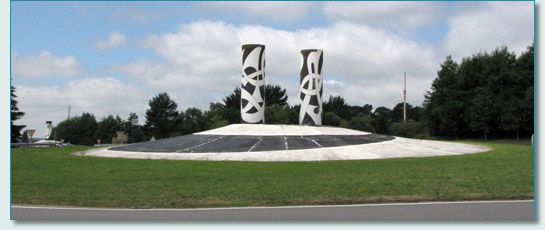
As the Maui Celtic travellers left Brittany, they came across a series of modern Celtic art roundabouts along the road ! A fitting end to their journey in the area musician Carlos Nuñez called "the Centre of the Celtic world" !
A modern Celtic art roundabout in Brittany
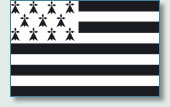
The Breton flag, the Gwenn ha Du, the 'White and Black', shows 9 black and white stripes, and a scattering of ermines. This represents 9 regions and 9 dioceses. Black is for the eastern Gallo region, which is Rennes, Nantes, Dol, St.Malo, and St. Brieuc. White is for the Breton speaking western region, which is Leon, Tregor, Cornouaille, and Vannes. The ermine is from the Duchy of Brittany flag since 1318.